First Pour.
I was in Boston this weekend for my Harvard Business School 10-year reunion. Harvard has always felt special to me — equal parts intimidating and inspiring.

In a very full-circle moment, my class asked me to moderate our discussion time.
We also had a special guest lecture from our class’ favorite professor, Shikhar Ghosh, on how to assess our impact and design more meaningful careers — and lives.
I had a lot of requests on socials to share what I learned, so here are 3 takeaways from Professor Ghosh’s lecture on life and impact:
1. “I have enough” is a strategy.
For high achievers, life can easily become default momentum: the next title, the next milestone, the next marker that you’ve “made it.”
It reminded me of the HBS case we studied on a prominent New York financier — someone who had reached the highest levels of business, prestige, and influence, and still got caught in the trap of constantly wanting more. That led him down a path of insider trading, fraud, and eventually, jail time.
If you never define enough, there is no finish line. And when you start to realize that time — not status — is the real scarce resource, the signal gets a lot clearer.
2. Privilege creates responsibility.
Access is not neutral. If you have education, networks, resources, or influence, the question can’t just be: What can I achieve? It has to be: What am I uniquely positioned to help solve?
Impact should be designed intentionally — not treated as a side effect of your next achievement.
3. AI makes human responsibility more important, not less.
The AI conversation wasn’t just about jobs being disrupted. It was about who redesigns the systems around it: incentives, institutions, access, trust, and care.
Technology can move fast, but humans still decide what it’s for — and who it serves. The burden lies with us to use AI to advance our work and impact, protect those most vulnerable, and build intentionally — rather than let it divide or diminish us.
That was my biggest reunion takeaway: the next decade should be less about default momentum and more about deliberate choices. We must take ownership for the decisions and outcomes in our life.
Even more of a reason to live intentionally, build with care, show empathy. Something to brew on ☕️
Today’s Tech Menu:
1. SpaceX completes the largest IPO in history and crosses a $2T valuation
My Tea: The essential tech stack is no longer FAANG. It’s MANGOS: Microsoft, Apple, Nvidia, Google, OpenAI, SpaceX.
2. Anthropic shuts down Fable and Mythos after U.S. export-control order
My Tea: Anthropic’s latest model releases have been riddled with drama & intrigue. This one raises the bigger question: national security... or national control?
3. OpenAI faces probe from 42 state attorneys general over ChatGPT user safety
My Tea: Regulators are digging into minors, privacy, health data, engagement, and consumer harm. Not exactly the dream roadshow backdrop.
4. Salesforce buys AI customer service startup Fin for $3.6B
My Tea: SaaSpocalypse where? Fin will bolster Salesforce’s Agentforce and hedge against companies trying to build their own.
5. Jeff Bezos’s physical AI startup Prometheus raises $12B at a $41B valuation
My Tea: You’re over here talking about LLMs, but Silicon Valley is already onto the next thing: world models, physical AI, and intelligence that moves off-screen, into the real world.
What’s been brewing.
I interviewed Okta Chief Product Officer Ely Kahn and Google Workspace head Andy Wen on what security and identity look like in the age of AI agents.
The big shift: when agents can access your data, tools, apps, and the internet on your behalf, everything we thought we knew about security changes.
Watch a clip below — and catch the full interview here.
Tokenmaxxing is having a moment in tech — but what does it actually mean?
I break down the concept below, and why it matters as AI usage, cost, and compute become strategic boardroom conversations in real time.
I also had the chance to speak with Guild.ai CEO James Everingham on this — more Tea on the chat next week.

Final Sip.
Last week, Stanford students walked out during Sundar Pichai’s commencement address. And it wasn’t an isolated moment: this commencement season has been riddled with student dissatisfaction and backlash to AI speakers.
Personally, disrespecting a speaker isn’t my cup of tea. But the signal is worth paying attention to: the next generation has real anxiety about what Big Tech is building — and what it means for their future.
And let’s be honest: new grads may be the first to feel AI’s impact on entry-level work.
But the story isn’t just doom & gloom IMO. I spoke with a senior leader at IBM here in New York yesterday who told me they’re hiring more interns and new grads than ever.
That framing matters. Even if AI automates parts of entry-level work, leaders will need to design systems to hire, train, and promote young people, despite the cost.
Because otherwise, who’s going to lead these companies in 10 to 15 years?
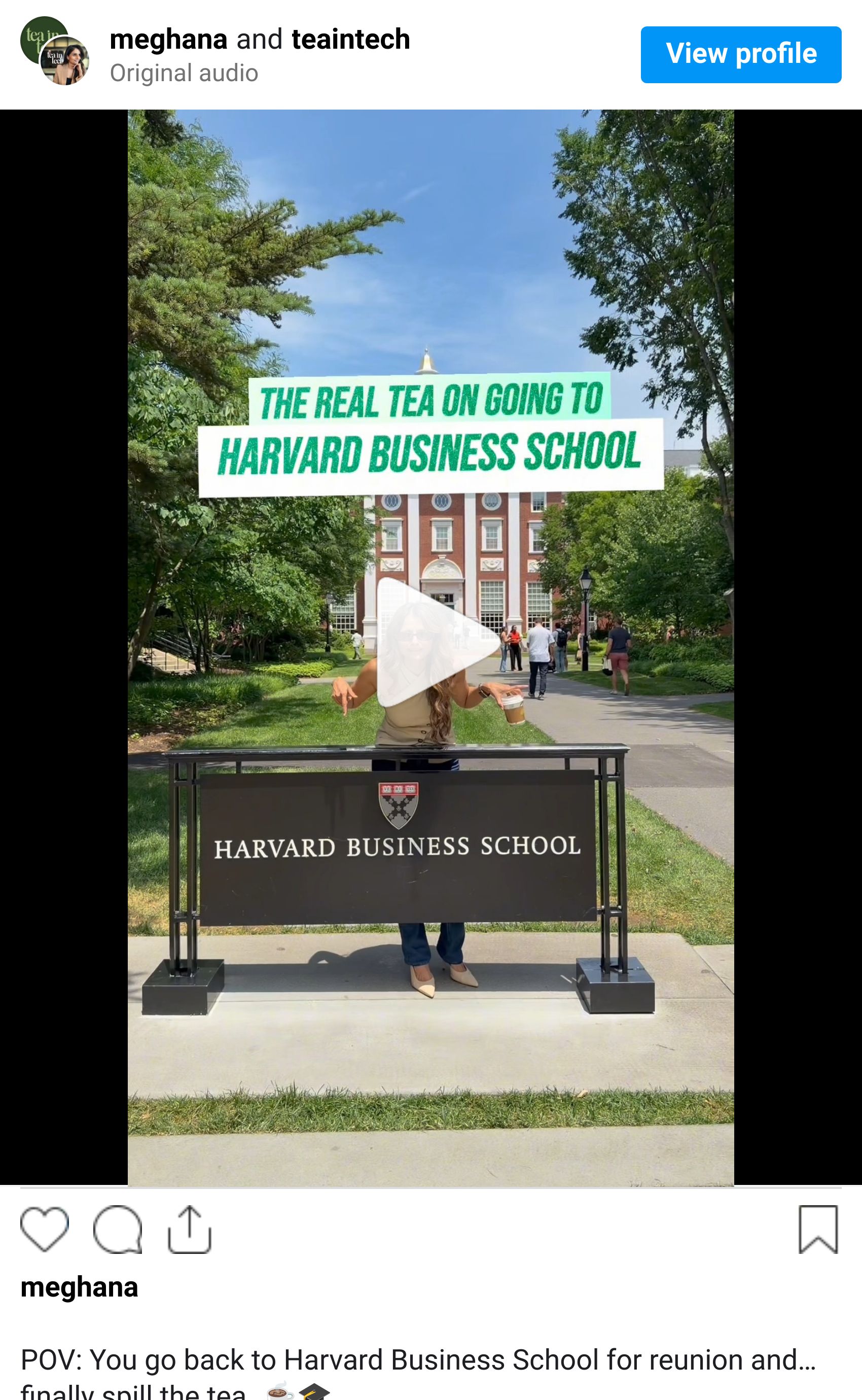
Many of you wanted more BTS content. So I tried something fun while I was at Harvard this weekend. The real Tea on going to HBS. See below
—
Keep calm and kettle on 🫖 -M