First Pour.
I’m finding the current media narrative around OpenAI vs. Anthropic so reductive.
It’s easy to frame this rivalry as one about heroes vs. villains. One company as the responsible safety-first actor. The other as the reckless security risk.
Prose written in black and white is so lazy.
The reality is, as usual, more nuanced than that.
Anthropic has built an incredibly strong trust and safety narrative, but let’s just spill it straight: Claude is still being used in U.S. military and intelligence operations via Palantir, despite the headlines.
And the Mythos situation (Anthropic's new model that was quietly released, then pulled back over vague "security risk" concerns and potential compute constraints) remains extremely opaque for a company that touts it transparency.
OpenAI, meanwhile, has had very real PR and governance issues. The ads are making people mad. But it also released GPT 5.5 and Images 2.0 this week, which are objectively world-class models. And let’s not forget — they started this whole generative AI thing.
So maybe the real story isn’t that one company is pure and the other, reckless.
Maybe it’s that both companies are excellent, both are ambitious, both are operating in morally complicated terrain, both are using “values” as part of their go-to-market strategy.
That doesn’t make either company bad. It makes them tech companies. Innovating, pushing limits, and yes, striving to drive shareholder value.
The sooner we stop expecting otherwise, the sharper our read on this industry gets.
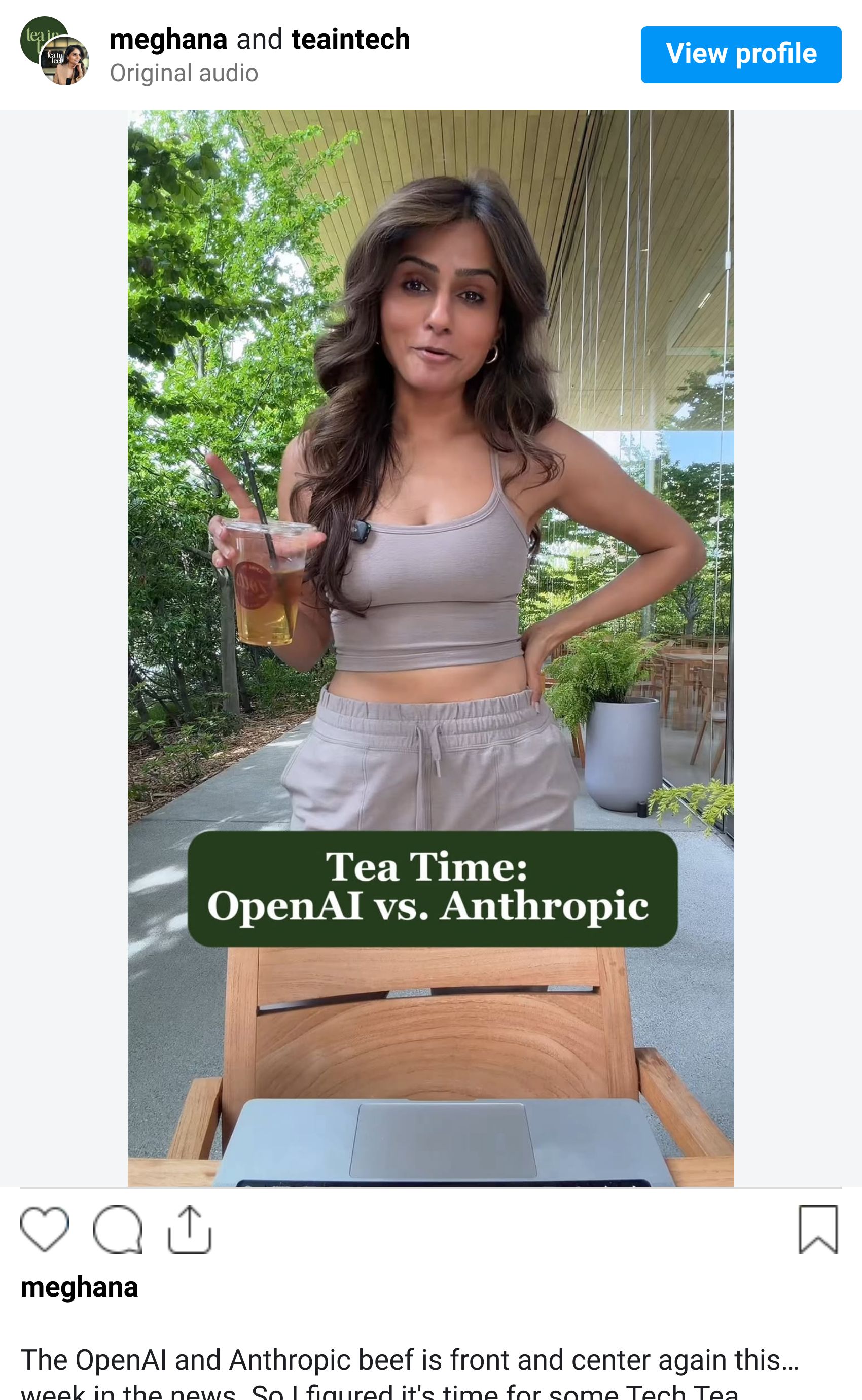
I break down the full OpenAI vs. Anthropic beef in my two-part series last week. See below.
Part I:
Part II:

Today’s Tech Menu:
1. Meta will train its AI on employees’ keystrokes and clicks
My Tea: Are they actually training the AI to understand how work gets done…or building reinforcement learning loops to, well, you know.
2. Google plans to invest up to $40B in Anthropic
My Tea: And of course, Anthropic runs its models on Google’s TPUs. We love a little Silicon Valley circular economics moment.
3. Apple names John Ternus as its next CEO
My Tea: Tim Cook scaled Apple into one of the most valuable companies in the world. John Ternus now has to prove Apple can keep up in the AI era. Here’s my full Tea on it.
4. OpenAI releases GPT-5.5 and ChatGPT Images 2.0
My Tea: Just as OpenAI is battling a messy PR moment, it drops some very, very good models. Arguably best in class.
5. Quantinuum, Honeywell’s quantum company, files for IPO
My Tea: AI may be the main character right now, but quantum computing is about to be the Valley’s next it girl.
What’s been brewing.
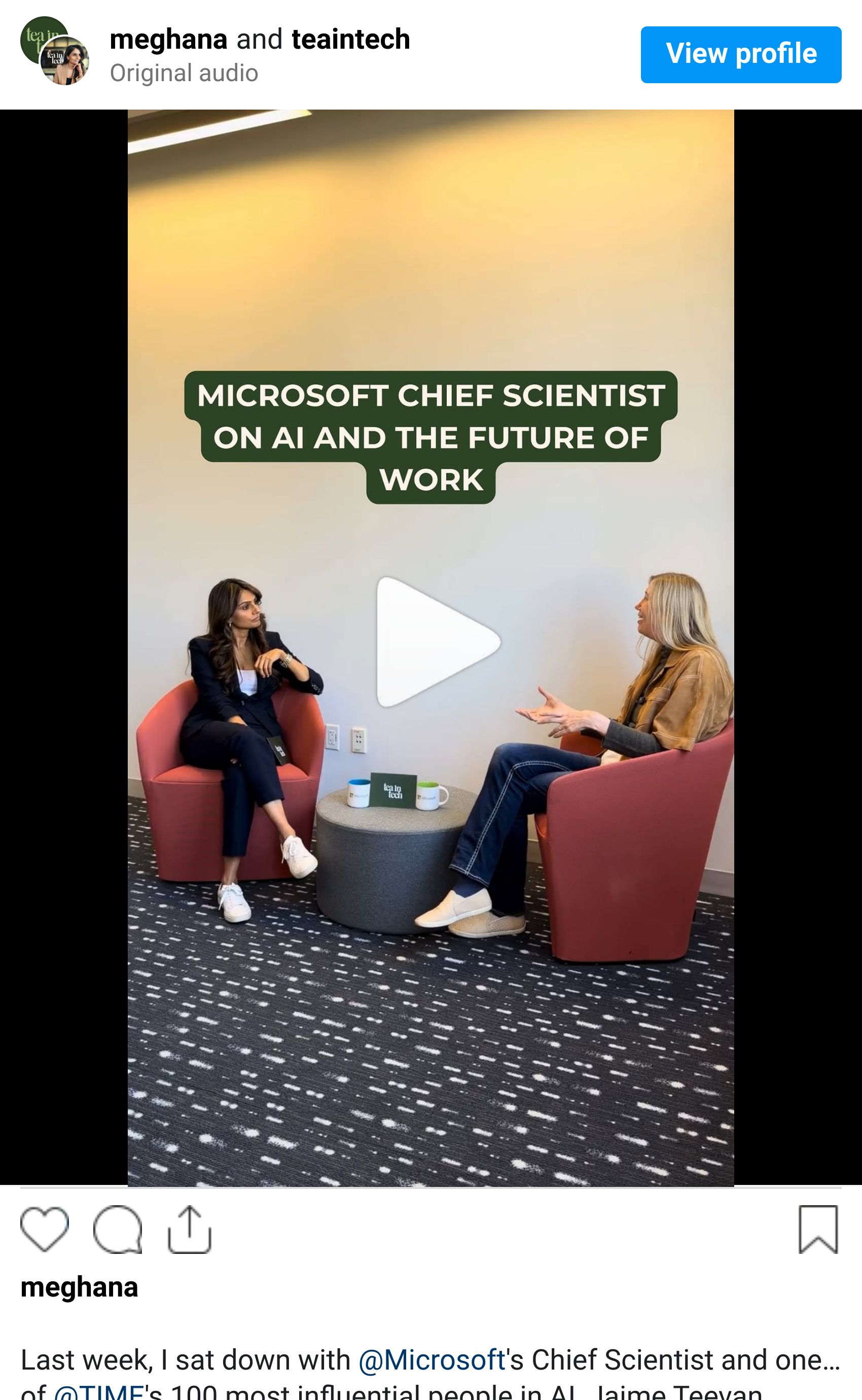
My full interview with Jaime Teevan, Chief Scientist at Microsoft and one of Time’s 100 most influential people in AI is live on YouTube.
A favorite clip from our chat, below:
Final Sip.
A delivery robot asked a man to press the crosswalk button for it, and he absolutely lost it.
He yelled at the robot for taking a human job while still needing a human to help it cross the street.
And listen, I get the frustration. Truly. There is something deeply absurd about being asked to assist the very automation that seems like it’s replacing people.
And maybe that’s the whole tension of this AI moment. People are angry, scared, and exhausted by the pace of automation.
But the thing we’re yelling at is usually just the visible endpoint of a much larger system: companies cutting costs, labor markets being reshaped in real time, and technology moving faster than culture can process.
We still have a say in how this plays out. But that requires us to lean in, ask the hard questions, and think critically about how we build, evaluate, and govern this new technology.
So yes, rage against the machine.
But don’t forget: that machine is ultimately a reflection of our society’s values and choices. And we play an active role in making them.
Something to brew on-
Meghana